Showing posts with label Tambaroora. Show all posts

The Life and times of Francis MacNamara - convict, poet and Goldminer

– All photographs by Joe Franklin –
Mark Gregory viewed through Guard's rifle look out
COCKATOO ISLAND CONVICT PRISON, Sydney.
Guard look outs Cockatoo Island
Francis MacNamara was imprisoned here before his transfer to Van Diemen's Land.
Solitary cells, Cockatoo Island.
Golden Gully diggings, Tambaroora, near Hill End,  NSW - scene of a great Australian  gold rush.
Rich alluvial  gold deposits were found along these creeks, triggering a gold rush in the early 1850's.
At its height, the town of Tambaroora was home to around 2,500 people - among them Francis MacNamara
- better known as Frank The Poet for his rebellious epic work 'A Convict's Tour To Hell'.
On gaining his freedom MacNamara, like many convicts headed for these goldfields.
The Arch - Golden Gully, Tambaroora, NSW. Once Australia's early gold miners had worked through the
ground surface of their lease, they had to dig down to bedrock through ancient river gravels
in search of new gold bearing seams. Massive erosion has exposed the underground
warren of mines that stretched 5 kilometres along this creek line from  Hill End to Tambaroora.
Gnarly tree, Golden Gully.
Close up erosion at Tambaroora Diggings, near Hill End, NSW.
Francis MacNamara was  - according to contemporary press reports - active here in the 1850's.
Although one journalist wrote disparagingly of the poet's potential as a gold miner, a witness
at his inquest claimed Frank The Poet was highly successful earning "hundreds of pounds a week"
- a small fortune in his day - from his work on these diggings.
Reflections Golden Gully, Tambaroora, NSW.
The town went into decline in the mid 1860's as most of its river gravels had been
picked over by the gold miners and by 1899 all active mining had ceased .
The creeks and gullies produced over 1,400kg of gold.
Remains of a Tambaroora pub. Like many gold miners, Frank was reputed to be a heavy drinker.
He wrote: "...it becomes the Irishman to drown the shamrock while he can".
Interpretive sign Hill End.
Mine Head, Hill End.
Exposed wall, Hill End Cottage.
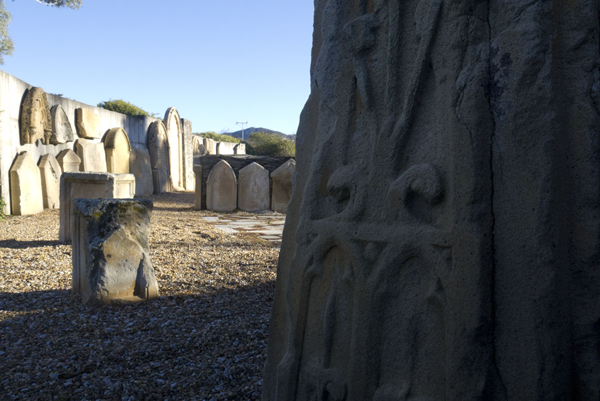
"Accidentally killed" - gravestone, Catholic Cemetery, Tambaroora, near Hill End NSW.
Gold mining was dirty , dangerous and often life threatening work. If the mine didn't kill you,
there was always the possibility that a fellow miner might.
Local historians say that the words "accidentally killed" on a gravestone was
sometimes a euphemism for a miner having a bucket dropped on his head.
Irish Section, Tambaroora Cemetery.
Gravestone, Irish Section, Tambaroora.
Grave stone of black tracker - David Benjamin Johnson, born USA.
Ted Abbott, grave digger, Tambaroora.
Mudgee Court House, NSW - opened in 1861 - the year of  Frank The Poet's death in Mudgee.
After a life time battling the law - his epic poem A Convict's Tour To Hell - turns the law on its head,
sending all the convicts to heaven and condemning the law makers to hell, Frank spent his last days
relatively peacefully by his standards living near Mudgee, and his inquest indicates
that like a number of Irish born poets, he quietly drank himself to death
Mudgee, NSW - the day before his death Frank was drinking in the town "on and off all day".
Memorial Park, Mudgee contains headstones from three earlier cemeteries - converted into parks.
Frank the poet died near here, but his burial place remains a mystery.

Tambaroora Gold

It's just about one year ago,
As near as I can guess,
Since last I trod old Sydney streets,
In sorrow and distress.
I'd squandered all my wealth away,
Misfortune had controlled,
But still a voice sung in my ear
Bright Tambaroora gold.

Chorus:
I've travelled for experience,
And oftentimes been sold,
But they don't get over Charley, or
His Tambaroora gold.

It's true I had seen better days,
Although I stood in rags;
My boots were all to pieces, and
My trousers patched with bags;
My friends and sweethearts slighted me,
And gave me turnips cold,
So I thought I'd try my luck amongst
The Tambaroora gold.

Chorus

The day I left old Sydney
A tear fell from my eye,
For amongst all my kind friends there was
Not one would say good bye.
But I on my journey staggered, till
At last I did behold
The hills that brightly glittered with
Bright Tambaroora gold.

Chorus

I had not long been on the field
Before I got a job,
And worked three months on wages for
A chap called "Dusty Bob"
By this a claim I purchased, and,
In turning up the mould,
My pile was soon created with
Bright Tambaroora gold.

Chorus

Then back I came to Sydney,
A regular dashing swell;
Then, strange to say, my previous foes
All seemed to wish me well -
Politely bowed and touched their hats,
As up the street I bowled;
And the girls got shook on Charley, with
The Tambaroora gold

Chorus

And ever since that very day
I've been a happy man,
For they treat me as a King or Prince,
And pet me all they can.
The ‘forties" kindly greet me, and
The "Bobbies", brave and bold -
They'd like to "touch" proud Charley for
His Tambaroora gold.

Chorus

Last week I was invited out.
I went — it was to lunch —
With a cove who thought to hocus me,
And make a jolly "punch".
Said he,"Come, Charley, try some schnapps,"
Said I, "Yes, so I'm told,
But you don't this time snap Charley, or
His Tambaroora gold".

Chorus

The other day I chanced to meet
Miss Angelina Vawn,
Who once gave me cold turnips, when
She found my money gone.
Said she, "Come to my bosom, Charles,
We lovers were of old."
But I know she loved not Charley,
But his Tambaroora gold.

Chorus

The other night I took a walk
Down by Prince Alfred Park,
(And I'm always on my guard, you know,
Especially after dark),
And there a cove rushed out at me,
As cautiously I strolled.
"Bail up!" cried he, 'and hand me out
Your Tambaroora gold."

Chorus:
I've paid for my experience, &c

I on to him flew like a bird,
And seized him by the wool,
And dashed him in the gutter, and
He bellowed like a bull.
He cried in sad confusion, as
He in the gutter rolled,
"Oh spare my life, the devil take
Your Tambaroora gold."

Notes


The Sydney Morning Herald places Frank the Poet working with a gold mining team at Tambaroora in 1853, and the evidence given by his friend of eight years at the Mudgee coroner's enquiry in 1861 suggests MacNamara made considerable money from the gold diggings in Tambaroora. Was this song written by him? or about him?

The Heritage Newsletter of the Blue Mountains Association of Cultural Heritage Organisations March - April 2010 has an article by John Low suggesting that this song was written by Katoomba identity, Harry Peckman, known as 'The Blue Mountains Poet' and shows an original broadside by 'Harry Peckman, Hartley'.

Sudden Death

A detailed report from the Coroners inquest appeared in the Western Post two days after MacNamara died:

From Western Post 31 August 1861 [transcribed from microfiche by Annette Piper 2002]
SUDDEN DEATH
An inquest as held on Friday morning, by W KING, Esq., M.D. Coroner for this District, at the Fountain of Friendship, on the body of Francis McNAMARA, alias HILL, better known as "Frank the Poet".

Robert WELSH having been sworn, said that the deceased had resided with him on the Pipe Clay Creek diggings. They came into Mudgee together on Wednesday, deceased left him, and promised to meet him by a certain time at Mr McQUIGGAN's. He then went to PHILLIPS', and found him in bed; he asked for some water; he was half drunk. He advised deceased to get up; he replied "Put your hand in my pocket and take out what is there". Had known him for eight years. He had a complaint which caused him to spit blood. He earned a great deal of money, and spent it very freely; had known him to obtain "hundreds a week" at Tambaroora. The wind used to annoy him very much in the hut in which he resided. He was no better for his visit to Mudgee. The day before they had been drinking together all day off and on.

John McDERMID deposed: That he had been working with previous witness since the end of last month; he came into Mudgee on Thursday to see what was keeping him and deceased. He met WELSH, who was nearly tipsy, in PHILLIPS' tap-room and said "You promised not to get drunk" He replied how can I help it, Frank is very bad. He then went to see deceased, who made no reply to a question he put to him respecting his health. Shortly after, he called WELSH and told him to get some money owing to him in Mudgee, and to give him (witness) half, and died directly after. He used to complain of a pain in his shoulder. During the time he resided with them his appetite was good. He had no effects, excepting some papers. He never cared for clothes. Arthur Thomas Piggott CUTTING, being duly sworn, stated that he was a duly qualified medical practitioner; he had viewed and examined the body and it was opinion that the deceased came to his death by the effects of cold and inanition. The jury found a verdict accordingly.

The same detailed report from the Western Post appeared in The Empire 4 September 1861
The news of his death was also carried in a shortened form in the NSW regional newspaper the Maitland Mercury:


The Maitland Mercury 7 September 1861
MUDGEE.
(From the Western Post, August 31.)
SUDDEN DEATH.—An inquest was held on the 30th,
before the coroner for the district, on the body of Francis
McNamara, better known as "Frank the Poet." It ap-
peared that McNamara was a digger at Pipe Clay Creek.
He had lately complained of a pain in the shoulder, and
had been spitting blood. The medical evidence was to
the effect that he had died from cold and inanition; and
the jury returned a verdict according to that evidence.
––––––––––––––

Notes


Paragon Hotel Mudgee - Owned by John McGuiggan - former name Bushman's Arms
MacNamara's death was reported in at least three NSW newspapers. These notices show that Francis MacNamara died on Thursday 29 August 1861.

The local Mudgee paper the Western Post suggests MacNamara made considerable money from his gold prospecting in Tambaroora, Hill End, corroborating the Sydney Morning Herald report of him working as a gold miner there at the end of 1853. Robert Welsh had 'known him for eight years' so would have met him then. Welsh's evidence is corroborated a year later in a report of him at Clarke's Creek, Meroo in the Bathurst Free Press and Mining Journal. The fact MacNamara 'earned a great deal of money and spent it very freely' conjures up the possibility he may have written 'Tambaroora Gold'.

Frank the Poet at Tambaroora

Tambaroora street sign Hill End (photo Mark Gregory Feb 2011)
The Sydney Morning Herald 8 September 1853

TAMBAROORA has suffered severely from the rush to Burrandong, and is by no means the place it once was; but a return tide has set in without, however, benefitting to any material extent the old digging grounds. Many of the return parties have commenced operations upon the Pyramul, where there is a vast extent of untried country, over which, upon the various points, upwards of a hundred diggers are scattered. Amongst these are Bush and Newman's party, formerly of Dirt Hole Creek, where they netted 70 and 30 ozs. of gold a short time ago, in two consecutive weeks, and a party of Germans, who have commenced sluicing with very fair success, the former being supplied with 300 yards of hose for the purpose. A local celebrity, who answers to the cognomen of Frank the poet, has added his physical and poetical strength to the former, where his bones and sinews are likely to be of more service than his brains.

Notes

MacNamara's presence as a gold miner in Tambaroora in 1853 is corroborated by evidence given to the the Coroner's inquest into his death in Mudgee in 1861:

Robert WELSH having been sworn, said that the deceased had resided with him on the Pipe Clay Creek diggings. ... Had known him for eight years. He had a complaint which caused him to spit blood. He earned a great deal of money, and spent it very freely; had known him to obtain "hundreds a week" at Tambaroora.

Now a ghost town, Tambaroora was once a thriving gold rush settlement. The Hill End-Tambaroora Gold Field was one of the richest gold mining areas in New South Wales, and the first reef mining area in Australia. Gold was discovered in 1851, but the ‘boom’ years were 1871-74, during which the population reached 8,000. The total production of gold from the district was over 50 tonnes; including the famous Beyers and Holtermann nugget (286 kg), the largest single piece of reef gold ever discovered.